Welcome to Arconomy
Arconomy is a no-code algorithmic trading platform that empowers traders to design, backtest, and deploy automated trading strategies — without writing a single line of code. Whether you are a seasoned quantitative trader or someone exploring systematic trading for the first time, Arconomy provides the tools you need to turn your market ideas into fully testable, deployable strategies.
Who Is Arconomy For?
Arconomy is designed for a wide range of traders and market participants:
- Discretionary traders who want to validate their intuition with historical data before risking capital.
- Systematic traders who need a faster way to prototype and iterate on strategy ideas without managing infrastructure.
- New traders who want to learn the mechanics of trading through a structured, visual approach.
- Portfolio managers who need to test allocation and risk management rules across multiple instruments.
No programming experience is required. If you can describe your trading idea in plain language, you can build it on Arconomy.
Key Concepts
Before diving into the platform, it helps to understand the core building blocks that Arconomy is built around. These concepts will appear throughout the documentation.
Strategies
A strategy is the top-level container for your trading logic. It defines what instruments you want to trade, under what conditions you enter and exit positions, and how you manage risk along the way. Every strategy is composed of one or more rules arranged on a visual canvas.
Rules
Rules are the individual building blocks of a strategy. Each rule represents a specific condition or action — for example, "enter a buy position with a stop loss of $100", "calculate the 20-period moving average", or "detect a reverse hammer candlestick". Arconomy provides a library of pre-built rules covering technical indicators, price action, risk management, and alternative data sources. You configure each rule's parameters to match your trading thesis.
The Canvas
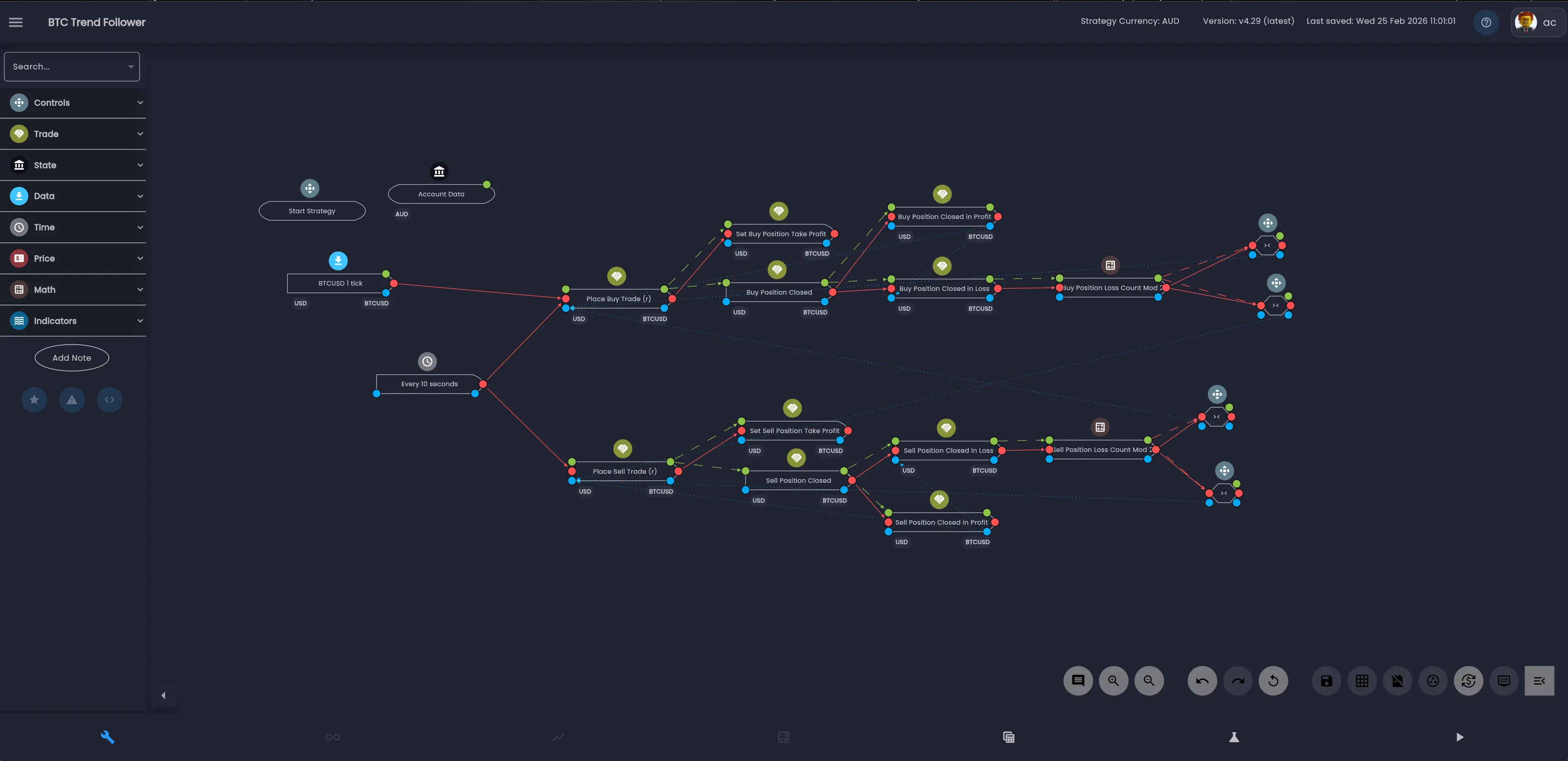
The canvas is the visual workspace where you design your strategy. You drag rules onto the canvas, connect them in the order they should be evaluated, and configure their parameters. The canvas gives you an at-a-glance view of your entire strategy's logic, making it easy to understand, modify, and share your trading ideas.
Backtesting
Backtesting is the process of running your strategy against historical market data to see how it would have performed in the past. Arconomy uses real tick-level data to simulate trade execution as accurately as possible, including spreads, slippage, and commission costs. Backtesting lets you evaluate your strategy's performance metrics — such as profit and loss, win rate, maximum drawdown, and risk-adjusted returns — before you commit real capital.
Deployment
Once you are satisfied with your strategy's backtest results, you can deploy it to trade live through a connected broker account. Arconomy handles the execution, monitoring, and management of your deployed strategies. You can start with a demo account to paper-trade before moving to live execution.
The Arconomy Workflow
Every strategy on Arconomy follows a three-phase workflow: Build, Test, and Deploy. This structured approach ensures that your trading ideas are thoroughly validated before any capital is at risk.
1. Build
Open the Strategy Designer and use the visual canvas to assemble your strategy. Start by adding the datasource rules for the instruments you want to trade, then add entry rules, exit rules, and risk management rules. Configure each rule's parameters to match your trading thesis. The canvas makes it easy to see the complete flow of your strategy at a glance.
2. Test
Run your strategy through Arconomy's backtesting engine using real historical tick data. Review the performance report to understand how your strategy would have behaved across different market conditions. Use the trade analysis tools to inspect individual trades, visualise rule states at each decision point, and identify areas for improvement. Iterate on your strategy by adjusting parameters or adding new rules, then backtest again.
3. Deploy
When your strategy consistently produces the results you are looking to achieve, connect a broker account and deploy it. Start with a demo account to confirm that live execution matches your backtest expectations, then transition to a live account when you are ready. Monitor your deployed strategy through the Arconomy dashboard.
The Build-Test-Deploy cycle is iterative. Most successful strategies go through many rounds of testing and refinement before deployment. Take your time in the testing phase — it is where the real edge is developed.
What You Will Learn
This Getting Started guide walks you through everything you need to go from signing up to running your first backtest. Here is what each section covers:
- Creating Your Account — Sign up, verify your email, and explore your dashboard for the first time.
- Platform Overview — A guided tour of every major area of the Arconomy interface.
- Creating Your First Strategy — A step-by-step tutorial that walks you through building a simple moving average crossover strategy.
- Running Your First Backtest — Configure and run a backtest, then interpret the results to understand your strategy's historical performance.
If you already have an account and are familiar with the platform, you can skip ahead to Creating Your First Strategy to jump straight into building.
Getting Help
If you get stuck at any point, here are some resources available to you:
- Documentation — You are here. Use the sidebar navigation to browse all topics.
- Contact support — Reach out via the contact page for direct assistance.
- Trading Ideas blog — Browse the Trading Ideas section for strategy inspiration and educational content.
Ready to get started? Head to the next section to create your account.
Was this helpful? Let us know