News Catalyst
Today's tape is being driven by risk-off geopolitical headlines rather than a scheduled data print. US Central Command confirmed that American forces struck three Iranian crude oil carriers following an IRGC attack on American naval vessels, and Washington cleared a $5 billion munitions sale to Saudi Arabia — a combination that pushes crude higher, bids the dollar as a safe haven, and sends cable into fast, one-sided intraday swings. Layered on top, the large beat in US non-farm payrolls has repriced Fed expectations and left USD momentum firmly in control of the pair. The scheduled economic calendar is empty for today, so there is no fixed release time to trade around; instead, headline risk arrives unannounced, which produces exactly the environment this system is designed for — expanded 15-minute ranges where several independent momentum signals fire within a few bars of each other. The trade-off is that headline-driven moves can reverse just as violently, which is why the entry filter demands a count of agreeing conditions rather than a single trigger.
Trade Summary
This is a momentum continuation system for GBPUSD on the 15-minute chart that replaces the usual single-trigger entry with a scored vote. Rather than firing on one indicator crossing one threshold, the strategy asks several independent momentum conditions the same question and only takes the trade when at least three of four conditions agree in the same direction on the same bar. The vote is tallied by the Logic Count rule, which is built for exactly this N-of-M confluence threshold, and the individual votes come from RSI, MACD and a pair of EMAs. Position risk is sized from ATR, so the stop widens automatically when the news-driven range expands.
The system is directionally neutral — it will take longs and shorts with identical logic — but it is not condition-neutral. It expects to perform best in high-volatility, trending or newly-breaking markets where momentum persists for several bars after the signal, and it expects to perform worst in quiet, mean-reverting sessions where the four conditions drift in and out of agreement and produce a stream of small losers. Today's geopolitical backdrop and a repriced dollar put GBPUSD squarely in the first category.
The Anatomy of the Trade
The Logic: What Inefficiency Are We Exploiting?
Every momentum indicator is a lagging transformation of price, and each one is wrong in its own characteristic way. RSI whipsaws in a tight range. MACD is slow to turn at a genuine reversal. A short EMA crossing a long EMA fires late in a fast move and repeatedly in a choppy one. Individually, each produces a signal quality that most intermediate traders find frustrating. The inefficiency this strategy targets is that their errors are largely uncorrelated while their genuine signals are not: when a real institutional flow moves cable, momentum shows up in the oscillator, the histogram and the moving-average spread within a bar or two of each other. When it is noise, they disagree.
Counting agreements instead of chaining them with a hard AND gate is the second half of the edge. A strict AND across four conditions is brittle — a single indicator lagging by one bar kills a good trade — while a single trigger is far too loose. Requiring three of four is the middle ground: it tolerates one laggard without opening the door to noise. The result is fewer trades than a single-indicator system and more trades than a full-confluence system, with a materially better ratio of signal to noise than either. The threshold itself is the strategy's main tuning dial, and it is the one parameter most worth testing honestly rather than optimising to the historical maximum.
Setup Requirements
- Primary rule: Logic Count set to a threshold of 3 of 4 directional conditions on the signal bar.
- Vote 1 — RSI: RSI(14) above 55 for longs, below 45 for shorts — a momentum bias filter, not an overbought/oversold reading.
- Vote 2 — MACD: MACD(12, 26, 9) line above its signal line for longs, below for shorts.
- Vote 3 — EMA spread: EMA(9) above EMA(21) for longs, below for shorts.
- Vote 4 — Price position: Close above EMA(21) for longs, below for shorts.
- Risk management: ATR(14) drives both the stop distance and the position size.
- Primary symbol: GBPUSD — deep liquidity, tight spreads through the London and New York sessions, and a strong tendency to trend intraday when a dollar or sterling catalyst is live.
- Timeframe: 15-minute charts — slow enough that the four votes are not dominated by tick noise, fast enough to produce several qualifying setups per week.
- Adaptability: The vote structure transfers cleanly to EURUSD, USDJPY and the major indices; retune the RSI bias levels and the ATR multiple per instrument rather than reusing these values.
Entry Rules
No single condition is sufficient on its own. The Logic Count rule evaluates all four conditions on the close of each 15-minute bar and only produces a signal when the count reaches the threshold, with every counted condition pointing the same way.
- Long entry: At least three of the four long conditions are true on the same bar — RSI(14) > 55 and MACD line above signal line and EMA(9) above EMA(21) and close above EMA(21) — with no short condition counted.
- Short entry: At least three of the four short conditions are true on the same bar — RSI(14) < 45 and MACD line below signal line and EMA(9) below EMA(21) and close below EMA(21) — with no long condition counted.
Enter at the close of the confirmation candle. Do not anticipate the count mid-bar; a condition that is true forty seconds before the close is frequently false at the close, and acting early is the fastest way to convert this system's edge into a coin flip.
Exit Rules
- Stop loss: 1.5 × ATR(14) from the entry price, placed at the moment of entry.
- Take profit: 3.0 × ATR(14), giving a 2:1 reward-to-risk ratio on every trade.
- Signal exit: Close the position if the Logic Count reaches the threshold in the opposite direction before either level is hit.
- Time exit: Close any position still open after 16 bars (four hours). Momentum that has not paid inside four hours on a 15-minute chart has usually stalled.
The stop loss is non-negotiable. On a news-driven day the same volatility that produces the setup can produce a 40-pip candle against you, and the only protection against that is a stop that was placed automatically at entry and is never widened afterwards.
Risk Management
- Risk per trade: 1–2% of account equity, fixed. Do not scale risk up after a winning run.
- Risk-to-reward: Minimum 2:1. At a 2:1 payoff the system only needs a win rate above roughly 34% to break even before costs.
- Position sizing: Size = (Equity × Risk%) ÷ (1.5 × ATR in pips × pip value). On a $25,000 account risking 1% ($250) with ATR(14) at 12 pips, the stop is 18 pips, so position size is $250 ÷ (18 × $10 per pip per standard lot) ≈ 1.39 standard lots.
- Maximum concurrent positions: One GBPUSD position at a time, and no more than two correlated dollar pairs open together — correlated positions multiply a single adverse dollar headline into a single oversized loss.
SYMBOL:       GBPUSD
TIMEFRAME:    15m

LONG ENTRY:   LOGIC COUNT >= 3 of 4 bullish conditions
               1. RSI(14) > 55
               2. MACD(12,26,9) line > signal line
               3. EMA(9) > EMA(21)
               4. Close > EMA(21)
               // Enter at close of the signal bar

SHORT ENTRY:  LOGIC COUNT >= 3 of 4 bearish conditions
               1. RSI(14) < 45
               2. MACD(12,26,9) line < signal line
               3. EMA(9) < EMA(21)
               4. Close < EMA(21)
               // Enter at close of the signal bar

STOP LOSS:    1.5 × ATR(14) from entry

TAKE PROFIT:  3.0 × ATR(14) — 2:1 reward-to-risk
               // Or opposite Logic Count threshold reached

TIME EXIT:    16 bars (4 hours)

RISK:         1–2% of equity per trade
               // One GBPUSD position at a time
Paste this block into a Strategy Note in the Arconomy Strategy Builder so the intent of every rule stays attached to the strategy as you iterate on it.
Common Pitfalls
The failure modes of a confluence-count system are different from those of a single-trigger system. Most of them come from misunderstanding what the count is actually measuring.
Trading it through a dead session
In the Asian session GBPUSD frequently ranges in a 15–20 pip band for hours. In that regime all four conditions hover near their thresholds and flip in and out of agreement, so the count crosses three repeatedly without any real momentum behind it. Restrict the strategy to the London and New York sessions, and skip any bar where ATR(14) is below its own 50-period average. A count of three in a dead market is measuring noise, not conviction.
Ignoring sterling and dollar event risk
Bank of England decisions, UK CPI and employment prints, and US payrolls or CPI all gap GBPUSD straight through an ATR-based stop. Today's geopolitical flow is a live example: an unscheduled headline can move cable further in one candle than the strategy's entire take-profit distance. Flatten open positions and stand aside for 30 minutes either side of any high-impact GBP or USD release. The strategy's edge is momentum persistence, and a gap is not persistence.
Lowering the threshold after a quiet week
When the system produces few signals, the temptation is to drop the count from three to two so that it trades more. That single change roughly doubles the trade frequency and removes most of what makes the system work — a count of two out of four is barely better than a coin flip on direction. Frequency is an output of the strategy, not a target to be engineered. If you need more trades, add a second instrument at the same threshold instead of loosening the threshold on this one.
Optimising the votes until the equity curve looks perfect
Four conditions, each with its own parameters, plus a threshold and two ATR multiples gives you a large enough search space to fit almost any historical curve. A backtest tuned to RSI 57.5, EMA 8/23 and a 1.4 ATR stop is describing the past, not a repeatable edge. Test the threshold at 2, 3 and 4 and keep the setting that is stable across all of them rather than the one with the highest return. If performance collapses when RSI moves from 55 to 57, the result was never real.
Revenge trading a losing streak
At a roughly 40% win rate, five consecutive losses is a normal statistical event, not evidence that the system is broken. The danger is doubling size on the next signal to recover, which converts a routine drawdown into an account-threatening one. Set a hard daily loss limit of 3% and a monthly review point at 10% drawdown, and stop trading when either is hit. Review the log then, not in the middle of the streak.
Build Strategy using Arconomy
The GBPUSD Logic Count Momentum Confluence strategy is assembled in the Arconomy Strategy Designer by wiring four independent momentum conditions into a single Logic Count rule and letting that rule's threshold decide when a trade is placed. No code is required.
| Step | Rule(s) Required | Description | Key Configuration |
|---|---|---|---|
| Data | Price Data | Feed 15-minute GBPUSD candles into the strategy as the base data source for every downstream rule. |
|
| Entry | Logic Count | The primary rule. Tallies how many of the four momentum conditions agree on the signal bar and fires only when the count reaches 3 of 4 in a single direction. |
|
| Entry | RSI | Vote 1. Supplies a momentum bias reading — not an overbought/oversold signal — to the Logic Count inputs. |
|
| Entry | MACD | Vote 2. Confirms that momentum is accelerating in the signal direction via the line/signal relationship. |
|
| Entry | Moving Average | Votes 3 and 4. Two EMAs supply the trend spread and the price-position check against the slower average. |
|
| Filter | Date Time | Restricts signals to the liquid London and New York sessions and blocks the thin Asian range where the count is unreliable. |
|
| Risk | ATR & Place Trade | Converts current volatility into a fixed-fractional position size so risk in currency terms stays constant as range expands. |
|
| Exit | Stop Loss & Take Profit | Places both exit orders at entry, with an opposing-count exit and a four-hour time stop layered on top. |
|
| Backtest | Run the strategy across multiple volatility regimes and confirm the threshold is stable before committing capital. |
|
Backtest Considerations
Test across a minimum of 24 months of 15-minute GBPUSD data, and make sure the window covers genuinely different regimes rather than one long trend. Cable's character changes materially between a Bank of England tightening cycle, a range-bound summer, and a geopolitical risk-off episode like the current one. A confluence-count system will look excellent in trending data and mediocre in ranging data, so a sample dominated by one regime will give you a number that has no predictive value. Segment the results by quarter and by session before drawing any conclusion.
The metrics that matter here are a profit factor above 1.3, a maximum drawdown you would actually tolerate in live trading, and — specific to this design — the distribution of trades across the count values. Log how many trades fired at exactly three votes versus all four, and compare their expectancy separately. If the three-vote trades are unprofitable in isolation, the threshold belongs at four and the extra frequency is costing you money. The Arconomy backtesting engine reports trade-level detail that makes this split straightforward to extract. Aim for at least 200 trades before you treat any of it as meaningful.
Model costs honestly. GBPUSD typically trades at a 0.8–1.5 pip spread through London and New York, but that widens to 3 pips or more at the daily rollover and during news spikes — precisely when this strategy is most likely to signal. Assume 1.2 pips of spread plus 0.5 pips of slippage per side as a baseline, and stress-test at double those figures. With an ATR-based stop of roughly 18 pips, costs eat close to 10% of the risk on every trade, and a backtest run at zero spread will overstate the edge by more than most traders expect.
Key Takeaways
- The edge comes from counting agreements between four uncorrelated momentum conditions rather than trusting any single indicator trigger.
- A 3-of-4 Logic Count threshold tolerates one lagging indicator without admitting the noise that a looser 2-of-4 threshold would let through.
- Every position is sized from ATR(14) with a fixed 1–2% risk and a minimum 2:1 reward-to-risk, so the stop widens with volatility while currency risk stays constant.
- Stand aside in the thin Asian session, when ATR is below its 50-period average, and around scheduled GBP or USD releases — the count is unreliable in all three.
- Backtest the threshold at 2, 3 and 4 across at least 24 months and 200 trades, and keep the setting that is stable rather than the one with the highest historical return.
Credits
The strategy idea originated from the following YouTube channel. Concepts have been adapted and structured for systematic implementation by Arconomy.
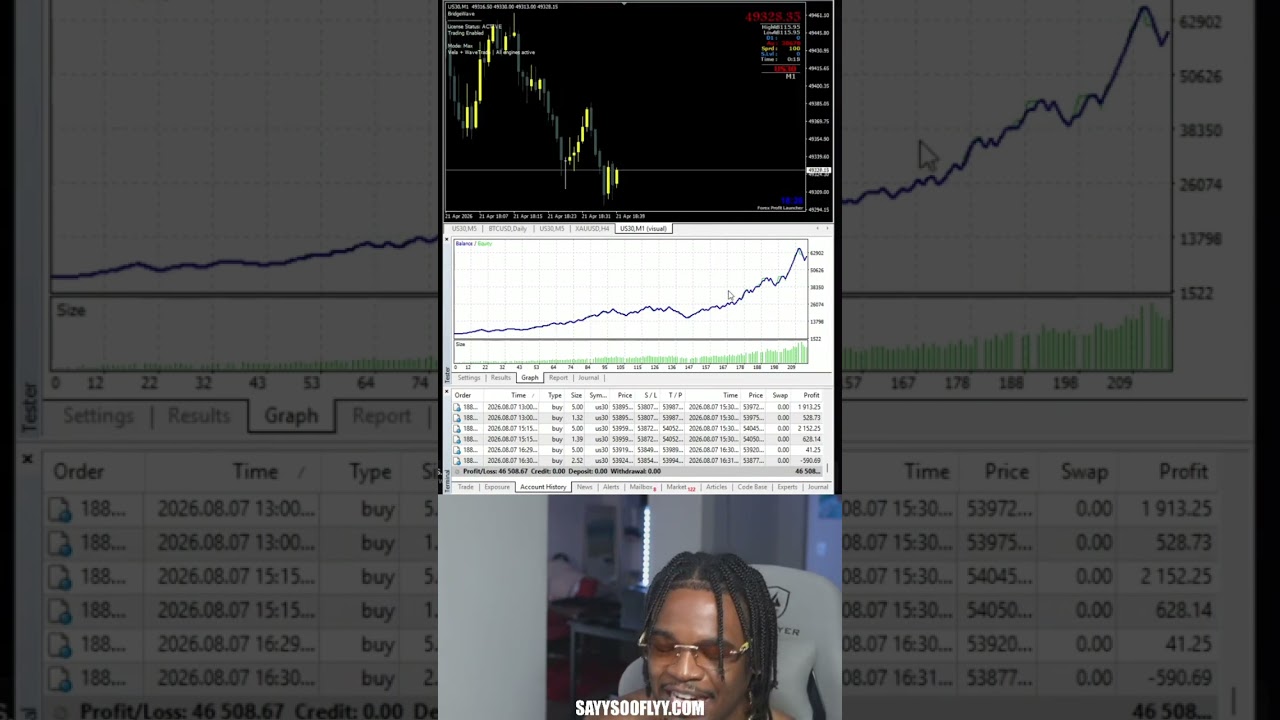
SayySooFlyy's video walks through live results from an automated bot that only takes trades when several of its momentum checks line up at once — that multi-condition gating approach is what this post formalises as a Logic Count threshold applied to GBPUSD on the 15-minute chart.