News Catalyst
The China A50 (CHINA50) opens the new quarter into a data-heavy session that hands this momentum system exactly the intraday range it needs. The headline release is the China RatingDog Manufacturing PMI, forecast at 51.6 against a prior 51.8 — a soft print would pressure the index on the open while a beat could ignite a directional push, either way widening the first-hour range that EMA crossovers thrive on. That domestic catalyst lands against a volatile global backdrop: Reuters reports Wall Street heads into its strongest quarter in years even as the US–Iran conflict persists, and that the Iran war and AI boom are driving a wild ride across global markets. With a US ISM Manufacturing PMI print (forecast 54) and a Fed Chair Warsh speech also on today's calendar, cross-market risk appetite can shift mid-session — a reminder to respect the strategy's stop and stand aside through the release windows themselves.
Trade Summary
This is a trend-confirmation momentum system that only takes a trade when price momentum and candlestick structure agree. It uses an Exponential Moving Average to define the prevailing intraday direction, then waits for a candlestick reversal pattern at the crossover to confirm that momentum is actually flipping rather than merely brushing the average. The result is a directional strategy — long above the EMA, short below it — designed to filter the whipsaws that punish naive moving-average systems in choppy conditions.
It is built for trending, higher-volatility sessions like today's, where a fresh catalyst gives the A50 a clean push away from its mean rather than a sideways grind. In a dead, range-bound tape the EMA flattens and crossovers cluster, so the candlestick filter and the ATR-based stop exist precisely to keep you out of those conditions and cap the cost of the false signals that do slip through.
The Anatomy of the Trade
The Logic: What Inefficiency Are We Exploiting?
Intraday index moves tend to trend once a catalyst forces participants to re-price. A single EMA captures that drift cheaply, but on its own it generates a signal every time price wobbles across the line — most of which are noise. The edge here comes from demanding confluence: the EMA must be sloping in the trade direction and a recognised candlestick pattern must print at the crossover before a position is opened.
The candlestick confirmation is what turns a lagging average into a timing tool. A Morning Star at an upward crossover, or a Bearish Engulfing at a downward one, tells you that the order flow behind the move has actually reversed — buyers or sellers have seized control at that exact bar. That pairing lets you enter early in the new leg while still refusing the dozens of marginal crosses that occur when price simply drifts through a flat EMA.
Setup Requirements
- Primary indicator: Exponential Moving Average (EMA), 20-period, applied to the close on the 15-minute chart.
- Confirmation: Candlestick pattern — Morning Star for longs, Bearish Engulfing for shorts — completing at the crossover bar.
- Risk management: Average True Range (ATR), 14-period, to size the stop to current volatility.
- Primary symbol: CHINA50 — a pure, policy-sensitive China A50 index proxy that produces clean, catalyst-driven intraday trends and deep liquidity during the Asian session.
- Timeframe: 15-minute — long enough to filter tick noise, short enough to capture several qualifying setups per session.
- Adaptability: The same EMA-plus-candlestick logic transfers to other liquid index CFDs (e.g. US500, GER40) and major FX pairs; re-tune the EMA length and ATR multiple per instrument.
Entry Rules
All conditions must align on the close of the same bar before a position is opened — the EMA relationship, the crossover, and the candlestick confirmation.
- Long entry: Price closes above the 20-period EMA and the EMA is sloping up and a Morning Star pattern completes at the crossover.
- Short entry: Price closes below the 20-period EMA and the EMA is sloping down and a Bearish Engulfing pattern completes at the crossover.
Enter at the close of the confirmation candle — never anticipate the pattern before the bar has finished forming.
Exit Rules
- Stop loss: 1.5 × ATR from entry, placed beyond the confirmation candle's extreme.
- Take profit: a minimum 2:1 reward-to-risk target, i.e. at least 3 × ATR from entry.
- Signal exit: close the position if price crosses back through the EMA or an opposing crossover signal prints, whichever occurs first.
The stop loss is non-negotiable — it is set at entry and never widened. On a news-driven day like today, a single un-stopped position can erase a week of disciplined trades.
Risk Management
- Risk per trade: 1–2% of account equity, fixed.
- Risk-to-reward ratio: minimum 2:1; skip setups whose logical target does not clear it.
- Position sizing: with a $25,000 account risking 1% ($250) and a 1.5 × ATR stop of 30 index points, size = $250 ÷ 30 = roughly 8 units per point.
- Maximum concurrent positions: one A50 position at a time; do not stack correlated index exposure.
SYMBOL:      CHINA50
TIMEFRAME:   15m

LONG ENTRY:
  Close > EMA(20)            // EMA sloping up
  Morning Star at crossover  // candlestick confirmation

SHORT ENTRY:
  Close < EMA(20)            // EMA sloping down
  Bearish Engulfing at crossover

STOP LOSS:   1.5 × ATR(14) from entry

TAKE PROFIT: 2:1 minimum reward-to-risk
             // Or price closes back across the EMA

RISK:        1–2% equity per trade
Copy the pseudo-code above into a Strategy Note inside the Strategy Builder so your rule intent stays documented alongside the logic itself.
Common Pitfalls
The strategy has a genuine edge, but it degrades quickly when the discipline behind it slips. The five failure modes below account for most of the drawdowns traders experience with EMA-plus-candlestick systems.
Trading a Flat EMA
When the A50 goes range-bound, the EMA flattens and price saws back and forth across it, firing crossover after crossover that immediately reverses. If the EMA is horizontal, there is no trend to ride — stand aside until slope re-establishes.
Ignoring Scheduled Releases
Today's China Manufacturing PMI, US ISM PMI and Fed Chair Warsh speech can gap the index straight through your stop. Do not hold a position into a high-impact release; let the print land, then trade the trend it creates.
Overtrading and Relaxing the Filter
After a couple of losers it is tempting to take the EMA cross without waiting for the Morning Star or Bearish Engulfing. Every trade must carry both the crossover and the candlestick confirmation — the filter is the strategy, not an optional extra.
Curve-Fitting the Parameters
Tuning the EMA length and ATR multiple until last month's chart looks perfect produces a system that only works on the data it was fitted to. Keep parameters round and robust, and validate across multiple market regimes rather than optimising to a single backtest.
Revenge Trading the Drawdown
A cluster of stop-outs during a choppy session tempts traders to double size to "win it back." Fixed fractional risk and a hard daily loss limit exist precisely to stop one bad session from becoming a blown account.
Build Strategy using Arconomy
Recreate the CHINA50 EMA Momentum Crossover in the Arconomy Strategy Designer by combining the rules below — no code required. Each row maps directly to a rule in the library.
| Step | Rule(s) Required | Description | Key Configuration |
|---|---|---|---|
| Data | Price Data | Feed CHINA50 15-minute candles into the strategy. |
|
| Entry | Moving Average | Define trend direction and the crossover trigger with an EMA. |
|
| Filter | Candle Pattern | Require a Morning Star (long) or Bearish Engulfing (short) at the crossover. |
|
| Confluence | Logic | Combine the EMA and candlestick conditions with an AND gate so both must be true. |
|
| Risk | ATR | Size the stop to current volatility with a 1.5 × ATR distance. |
|
| Exit | Stop Loss & Take Profit | Attach the ATR stop and a 2:1 reward target; exit early on an opposing EMA cross. |
|
| Backtest | Validate across trending and ranging regimes before going live. |
|
Backtest Considerations
Test the CHINA50 EMA Momentum Crossover over at least 12 months of 15-minute data so the sample spans both trending phases and the flat, range-bound stretches where the strategy is designed to sit out. The Asian-session index has distinct volatility regimes around Chinese policy announcements and quarter-ends, so make sure your window includes several of those events rather than a single benign quarter.
Judge the system on more than net profit. Look for a profit factor above 1.3, a maximum drawdown you could actually tolerate in live trading, and a trade distribution that is not dependent on one or two outlier winners. A healthy equity curve here should show many small, quickly-stopped losers offset by a steady tail of 2:1 winners — the signature of a working momentum filter.
Model costs honestly. CHINA50 CFD spreads widen at the open and around news, and slippage on ATR-based stops during a PMI or ISM release can materially exceed the modelled fill. Build in a realistic spread, add slippage on both entry and stop, and confirm the edge survives those frictions before committing real capital.
Key Takeaways
- The core edge is confluence: an EMA crossover only becomes a trade when a candlestick reversal confirms momentum has genuinely flipped.
- The candlestick filter and ATR stop exist to keep you out of flat, range-bound conditions where naive moving-average systems bleed.
- Risk a fixed 1–2% per trade, target a minimum 2:1 reward, and never widen the 1.5 × ATR stop once it is set.
- Stand aside through today's China PMI, US ISM and Fed Chair Warsh windows — trade the trend the release creates, not the release itself.
- Backtest across at least 12 months and multiple regimes with realistic spread and slippage before trading the strategy live.
Credits
The strategy idea originated from the following YouTube channel. Concepts have been adapted and structured for systematic implementation by Arconomy.
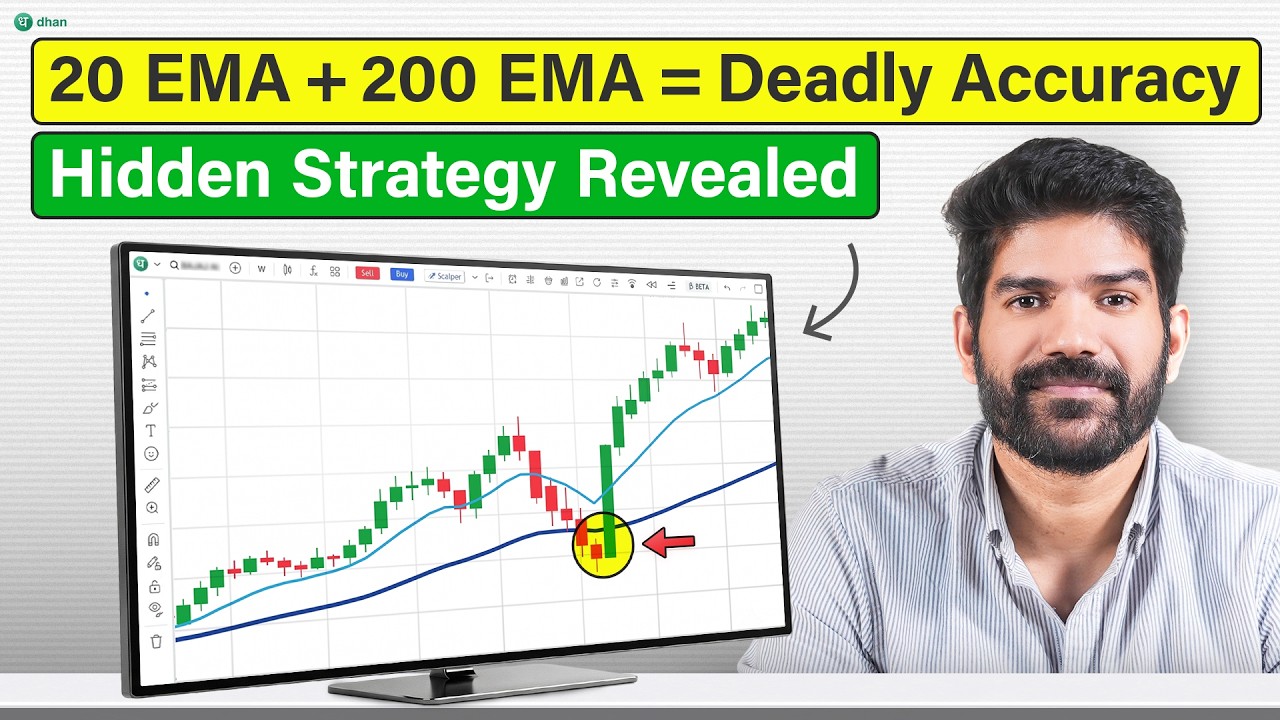
The source video by Dhan ⚡ demonstrates a moving-average intraday method that pairs an EMA with candlestick confirmation for timing entries — the exact confluence principle this post systematises into rule-based EMA-plus-pattern entries on CHINA50.