News Catalyst
Brent crude (XBRUSD) heads into the session with a clear geopolitical bid after the UN paused its Hormuz evacuation plan when a ship reported an attack — the Strait of Hormuz carries roughly a fifth of seaborne oil, so any shipping disruption there feeds an immediate supply-risk premium and elevated intraday range in Brent. That headline-driven volatility is amplified by a broader risk-off tone: bond ETF inflows surged a “shocking” 60% as investors hunt real yield while Bitcoin broke down toward $58K, signalling capital rotating out of speculative assets. With the economic calendar empty of scheduled high-impact prints for today, the directional energy in oil is coming from the Hormuz headlines themselves — precisely the kind of fast, one-sided expansion this low-lag trend system is designed to ride rather than fade.
Trade Summary
This is a low-lag trend-following system that uses a Hull Moving Average to catch directional sweeps the moment momentum confirms, then leans on a candlestick trigger to time the entry. The Hull Moving Average (HMA) reacts far faster than a conventional EMA, so when Brent “sweeps” a prior swing high and the HMA turns up beneath price, the strategy is already positioned for the continuation leg. It is a directional system — long when the HMA slopes up, short when it slopes down — and it is built to perform in high-volatility, trending conditions rather than quiet ranges. To avoid being whipsawed by the HMA’s speed, entries require an ADX reading that confirms a genuine trend is in force and a Pin Bar or Shooting Star at the point of entry, with ATR sizing the stop.
On a geopolitically charged day for crude, the edge is timing: catch the sweep early, demand confirmation, and let the trend pay for the noise the HMA inevitably catches in chop.
The Anatomy of the Trade
The Logic: What Inefficiency Are We Exploiting?
Markets that are reacting to a fresh supply shock — like a Hormuz shipping scare — tend to move in persistent, one-directional bursts as participants reprice risk faster than they can be arbitraged back. Most lagging trend filters enter these moves too late, after the bulk of the expansion is over. The Hull Moving Average compresses that lag dramatically, so a trader using it sees the trend flip while there is still room to run. The inefficiency we exploit is the gap between when a trend genuinely begins and when slower, more popular indicators finally acknowledge it.
The catch is that a fast average also flips on noise. That is why the real edge here is confluence: the HMA tells us a trend has turned, ADX tells us the turn has conviction behind it, and the candlestick trigger — a Pin Bar rejecting lower or a Shooting Star rejecting higher — tells us the immediate order flow agrees at the price we are about to trade. The candlestick confirmation adds a final, price-action veto that filters out the false flips the HMA would otherwise take in a directionless tape.
Setup Requirements
- Primary indicator: Hull Moving Average (HMA), period 21, applied to close.
- Trend filter: ADX with a 14-period setting, requiring a reading above 25 to confirm a directional regime.
- Confirmation: a Bullish Pin Bar for longs or a Shooting Star at resistance for shorts.
- Risk management: ATR (14-period) to size the stop at 1.5× ATR from entry.
- Primary symbol: XBRUSD (Brent crude) — its sensitivity to supply-side geopolitics produces the clean, high-momentum sweeps the HMA is built to capture.
- Timeframe: 15-minute charts — fast enough to capture intraday news-driven trends while filtering tick noise.
- Adaptability: the same template works on other trending instruments — index futures or major FX pairs — provided ATR and HMA periods are re-tuned to the instrument’s volatility.
Entry Rules
All conditions must align before a position is taken — the HMA direction, the ADX confirmation, and the candlestick trigger.
- Long entry: the HMA turns upward and price closes above it and ADX is above 25 and a Bullish Pin Bar prints at the entry candle.
- Short entry: the HMA turns downward and price closes below it and ADX is above 25 and a Shooting Star prints at resistance.
Enter at the close of the confirmation candle — never anticipate the HMA flip before the candle completes.
Exit Rules
- Stop loss: 1.5× ATR from entry, placed beyond the confirmation candle’s extreme.
- Take profit: a minimum 2:1 reward-to-risk target.
- Signal exit: close the position if the HMA reverses direction or price closes back across it before the target is reached.
The stop loss is non-negotiable. On a news-driven oil day a single un-stopped reversal can erase a week of disciplined gains, so the ATR stop is set before the trade is taken and never widened.
Risk Management
- Risk per trade: 1–2% of account equity, fixed in advance.
- Risk-to-reward: a minimum of 2:1, so the strategy stays profitable even below a 50% win rate.
- Position sizing: with a $10,000 account risking 1% ($100) and a stop of 1.5× ATR equal to 30 pips, size the position so each pip is worth roughly $3.33 — never override this with a “conviction” trade.
- Maximum concurrent positions: one open XBRUSD position at a time to avoid stacking correlated oil exposure during a single news cycle.
SYMBOL:       XBRUSD (Brent crude)
TIMEFRAME:    15m

LONG ENTRY:
  HMA(21) turns up AND price closes above HMA
  AND ADX(14) > 25
  AND Bullish Pin Bar prints

SHORT ENTRY:
  HMA(21) turns down AND price closes below HMA
  AND ADX(14) > 25
  AND Shooting Star prints at resistance

STOP LOSS:    1.5 × ATR(14) from entry

TAKE PROFIT:  2:1 minimum reward-to-risk
             // Or exit early if HMA reverses direction

RISK:         1-2% of equity per trade
Add this logic to a Strategy Note in the Strategy Builder so the entry, filter and exit conditions stay documented alongside the rules you wire up.
Common Pitfalls
The HMA’s greatest strength — its speed — is also where most traders lose money with it. These are the failure modes to guard against.
Trading the HMA in a Range
When ADX is low and Brent is coiling, the Hull Moving Average flips back and forth on every candle, manufacturing a stream of false signals. If ADX is below 25, there is no trade — the ADX filter exists precisely to keep you out of these chop-driven HMA flips.
Ignoring the Next Oil Headline
Crude is uniquely exposed to scheduled inventory data, OPEC+ commentary and live geopolitical wires. A fresh Hormuz or OPEC headline can gap straight through your ATR stop, so size for the possibility of a violent reversal rather than assuming an orderly exit. Check the wires before adding risk into a known event window.
Relaxing the Confirmation Requirement
After a couple of missed moves, it is tempting to enter on the HMA flip alone without waiting for the Pin Bar or Shooting Star. Every skipped confirmation converts a disciplined trend system into a coin-flip on a fast-moving average. The candlestick trigger is the part of the edge that filters the noise — dropping it removes the edge.
Over-Optimising the HMA Period
It is easy to curve-fit the HMA length and ADX threshold to whatever happened last week. Parameters tuned to a single regime almost always fall apart in the next one, so favour round, robust settings (HMA 21, ADX 25) that survive across multiple market conditions rather than the values that maximised one backtest.
Revenge Trading After a Stop-Out
Because the HMA enters early, it will occasionally stop out right before the real move. Re-entering immediately at a worse price to “get it back” is how a normal drawdown becomes a blown account. Take the stop, wait for the next clean setup, and let the 2:1 reward profile do the recovering.
Build Strategy using Arconomy
Here is how to assemble the XBRUSD HMA Higher-High Sweep Trend in the Arconomy Strategy Designer, mapping each rule above to a build step.
| Step | Rule(s) Required | Description | Key Configuration |
|---|---|---|---|
| Data | Price Data | Feed XBRUSD 15-minute candles into the strategy. |
|
| Entry | Moving Average | Detect the trend turn using a Hull Moving Average and require price to close on the correct side of it. |
|
| Filter | ADX | Confirm a genuine directional regime before allowing entries, filtering out range-bound HMA flips. |
|
| Confirmation | Candle Pattern | Require a Pin Bar (long) or Shooting Star (short) on the entry candle. |
|
| Risk | ATR + Place Trade | Size the stop from volatility and place the trade with fixed fractional risk. |
|
| Exit | Take Profit | Target a 2:1 reward-to-risk, with an early exit if the HMA reverses. |
|
| Backtest | Validate the assembled strategy across multiple oil regimes before going live. |
|
Backtest Considerations
Test this strategy over a minimum of twelve months of XBRUSD 15-minute data so the sample spans both quiet, range-bound stretches and the violent, news-driven trends the system is built for. Brent’s behaviour shifts sharply between calm consolidation and supply-shock expansions, and a backtest that omits at least one geopolitical episode will badly overstate the HMA’s reliability.
Focus on the right metrics rather than headline return. Look for a profit factor above 1.3, a maximum drawdown you could realistically sit through, and a trade distribution that is not dependent on one or two outlier weeks. Because the HMA enters early, expect a moderate win rate carried by the 2:1 reward profile — verify the average winner genuinely exceeds twice the average loser.
Model costs honestly for crude. Brent spreads widen during the news events that generate the best signals, and slippage on a 15-minute breakout can be material, so add a realistic spread-and-slippage buffer and confirm the edge survives it. Thin liquidity around the daily oil settlement window can also distort fills — consider filtering those candles out of both the backtest and live trading.
Key Takeaways
- The Hull Moving Average enters trends earlier than a conventional EMA, capturing the start of news-driven sweeps in Brent crude that slower filters miss.
- Confluence is the edge: HMA direction, an ADX reading above 25, and a candlestick trigger must all agree before a trade is taken.
- Every position is sized with a 1.5× ATR stop and 1–2% account risk, with a minimum 2:1 reward-to-risk target.
- Avoid the strategy in low-ADX ranges and around scheduled oil events, where the fast HMA produces false flips and gap risk.
- Backtest across at least twelve months covering both quiet and shock regimes, and confirm the edge survives realistic crude spreads and slippage.
Credits
The strategy idea originated from the following YouTube channel. Concepts have been adapted and structured for systematic implementation by Arconomy.
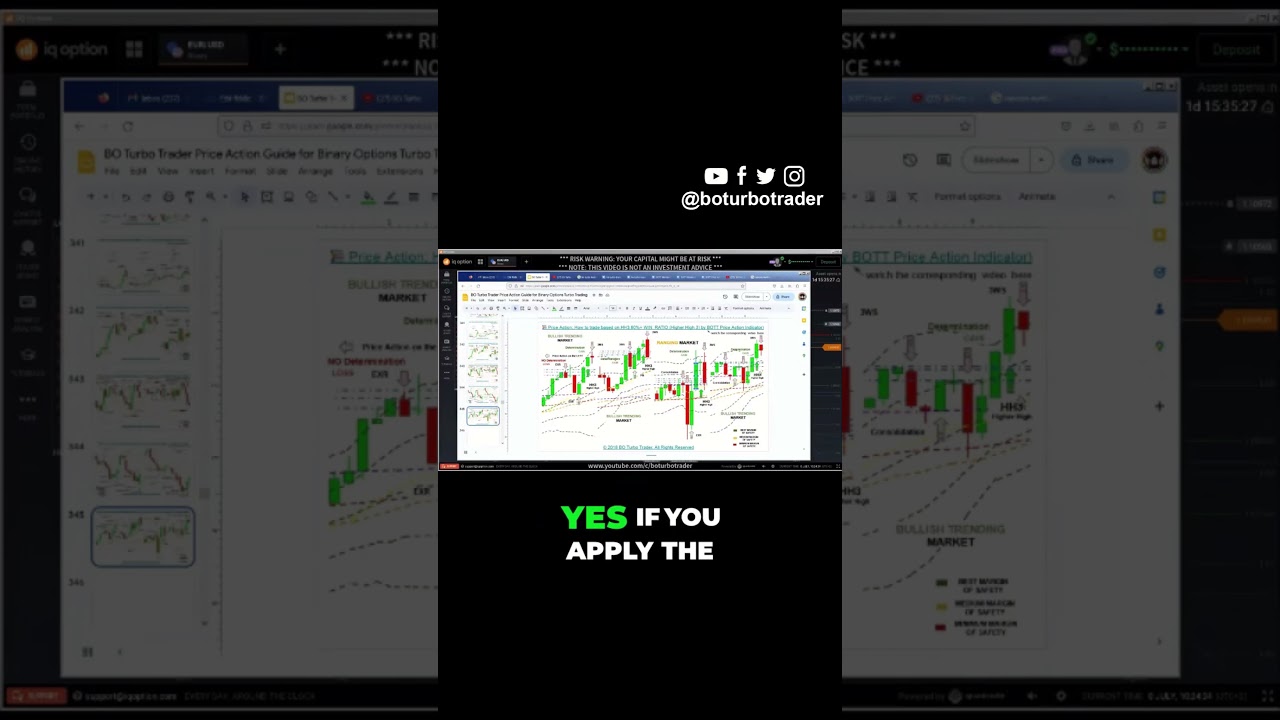
BO Turbo Trader’s “Higher High Sweep” walkthrough demonstrates how to read a swing-high liquidity sweep and time an entry off the rejection candle — the same sweep-and-confirm logic this post systematises with a Hull Moving Average trend flip, an ADX filter, and a Pin Bar / Shooting Star trigger on XBRUSD.