News Catalyst
Today's session opens against a backdrop of heightened geopolitical risk and a pending US data print — precisely the conditions a volume-driven momentum system is built to exploit. Reuters reports that Iran is studying a deal to halt war while talks continue, even as Israel strikes south Lebanon — headlines that drive abrupt safe-haven rotation into the US dollar and inject sharp, news-fed bursts into GBPUSD. On the scheduled side, the US ISM Services PMI (forecast 53.8 vs. 53.6 prior) lands today and is the session's primary dollar catalyst; a beat or miss against that consensus typically triggers an immediate volume surge on the pair, while Australia's GDP Growth Rate QoQ (forecast 0.5% vs. 0.8% prior) shapes broader risk tone ahead of the London–New York overlap. Because each of these catalysts arrives as a discrete, time-stamped shock rather than a slow drift, they manufacture exactly the participation spikes this strategy uses to confirm genuine directional intent.
Trade Summary
This is a volume-confirmed momentum breakout for GBPUSD on the 15-minute chart. The core problem it solves is the false breakout: price pokes through a level on thin participation, traps breakout buyers, then reverses. By requiring a genuine Volume expansion at the moment price clears a defined Price Level, the system filters out the low-conviction probes and only commits when real flow is behind the move.
The strategy is directionally agnostic — it takes longs on bullish volume-backed breakouts and shorts on bearish volume-backed breakdowns — so it performs best in high-volatility, news-driven sessions where order flow is decisive and trends extend intraday. It is confirmed by a candle pattern (engulfing close beyond the level) and risk is framed with ATR so stops adapt to the current range. It is at its weakest in quiet, range-bound conditions where volume spikes are noise rather than signal.
The Anatomy of the Trade
The Logic: What Inefficiency Are We Exploiting?
Markets move when participants commit capital, and that commitment leaves a footprint in volume. A price level that breaks on average or below-average volume is being tested by a thin pool of traders — the kind of move that is easily absorbed and faded. A break that coincides with a volume spike of 1.8× or more above the 20-period average signals that institutional-sized flow is stepping in, and that the inefficiency — resting liquidity above resistance or below support — is being actively consumed.
The edge comes from confluence: price location, participation, and candle structure must agree before a trade is taken. The Price Level defines where the opportunity is, the Volume spike confirms whether it is real, and the engulfing candle confirms when momentum has actually shifted. Each filter individually produces too many false signals; stacked together, they isolate the breakouts that have the order-flow backing to follow through.
Setup Requirements
- Primary indicator — Volume: 20-period volume moving average; entry requires the breakout bar's volume to exceed 1.8× the average.
- Confirmation — Candle Pattern: a bullish or bearish engulfing candle that closes beyond the level.
- Reference level — Price Level: the prior swing high/low or the 20-period range boundary that price must clear.
- Risk management tool — ATR: 14-period ATR to size the stop to current volatility.
- Primary symbol — GBPUSD: deep liquidity and reliable tick-volume data make participation spikes meaningful, and the pair’s sensitivity to UK and US data delivers frequent clean breakouts.
- Timeframe — 15m: long enough to filter intrabar noise yet short enough to capture the volume surge while the move is still developing.
- Adaptability: the framework transfers to other major FX pairs (EURUSD, USDJPY) and liquid index futures, but the volume multiplier should be re-tuned per instrument.
Entry Rules
All conditions must align on the close of the 15-minute bar before a position is opened.
- Long entry: price closes above the reference Price Level and breakout-bar volume > 1.8× the 20-period average and the bar is a bullish engulfing candle.
- Short entry: price closes below the reference Price Level and breakout-bar volume > 1.8× the 20-period average and the bar is a bearish engulfing candle.
Enter at the close of the confirmation candle — do not anticipate the break before volume and structure have printed.
Exit Rules
- Stop loss: 1.5× ATR(14) from the entry price, placed on the opposite side of the breakout level.
- Take profit: a minimum 2:1 reward-to-risk target (3.0× ATR), scaled out if momentum stalls.
- Signal exit: close the position on an opposing volume-backed signal or after a maximum hold of 4 hours, whichever comes first.
The ATR stop is non-negotiable: a volume breakout that fails to follow through is the strategy’s primary loss mode, and the fixed stop is what keeps those failures small.
Risk Management
- Risk per trade: 1–2% of account equity, fixed per position.
- Risk-to-reward ratio: minimum 2:1; skip any setup whose nearest obstacle blocks a 2:1 target.
- Position sizing: on a $10,000 account risking 1% ($100) with a stop of 1.5× ATR equal to 18 pips, position size is roughly 0.55 standard lots ($100 ÷ (18 × $10 per pip)).
- Maximum concurrent positions: one GBPUSD position at a time to avoid stacking correlated dollar exposure.
SYMBOL:      GBPUSD
TIMEFRAME:   15m

LONG ENTRY:
  close > reference Price Level
  volume > 1.8 × 20-period average
  bullish engulfing candle

SHORT ENTRY:
  close < reference Price Level
  volume > 1.8 × 20-period average
  bearish engulfing candle

STOP LOSS:   1.5 × ATR(14) from entry

TAKE PROFIT: 2:1 minimum reward-to-risk
             // Or exit on opposing volume signal / 4-hour max hold

RISK:        1-2% of equity per trade
Copy this pseudo code into a Strategy Note in the Arconomy Strategy Builder so the logic sits alongside the rules as you assemble them.
Common Pitfalls
This strategy has a genuine edge, but it is unforgiving of poor discipline. The most common ways traders erode its performance are below.
Trading It in Low-Volatility, Ranging Conditions
In a quiet, range-bound market, volume spikes are frequent but meaningless — they reflect routine churn, not directional commitment. Outside of active sessions and news windows, the volume filter loses its discriminating power and the breakouts it flags will overwhelmingly fail. Restrict the strategy to the London and New York sessions where participation is real.
Ignoring High-Impact GBPUSD News Events
A volume spike that coincides with a scheduled release like the US ISM Services PMI, a Fed decision, or UK CPI can be a whipsaw rather than a trend. Entering blind into the spike around a data print is the fastest way to be stopped on both sides of a single bar. Either stand aside for the first one to two bars after a release or widen the ATR stop to account for the elevated range.
Overtrading and Relaxing Entry Requirements
After a quiet stretch, the temptation is to lower the volume multiplier or accept a non-engulfing candle just to get filled. Every relaxation of the entry criteria reintroduces exactly the false breakouts the confluence was designed to remove. If the three conditions do not align, there is no trade — flat is a position.
Curve-Fitting the Volume Multiplier
It is easy to backtest dozens of multiplier and ATR combinations until one shows a beautiful equity curve. A multiplier optimised to the third decimal place is almost always fitted to noise and will not survive live conditions. Prefer round, robust values (1.8×, 2.0×) that hold up across multiple market regimes.
Revenge Trading After a Drawdown
Volume breakout systems cluster their losses during choppy transitions between trends. Chasing those losses with oversized positions turns a normal, recoverable drawdown into account-threatening damage. Hold position size constant and step away after a pre-defined daily loss limit is hit.
Build Strategy using Arconomy
Recreate the GBPUSD Volume Spike Momentum Strategy in the Arconomy Strategy Designer by chaining the rules below. Each row maps a step in the logic to the specific rule and configuration you need.
| Step | Rule(s) Required | Description | Key Configuration |
|---|---|---|---|
| Data | Price Data | Feed in GBPUSD 15-minute OHLC and volume data as the foundation for every rule. |
|
| Entry | Volume Data | Detect the volume spike that confirms genuine participation behind the breakout. |
|
| Entry | Price Level | Define the breakout/breakdown level price must close beyond. |
|
| Filter | Candle Pattern | Require an engulfing candle in the breakout direction as final confirmation. |
|
| Risk | ATR | Size the stop to current volatility so it adapts as range expands and contracts. |
|
| Exit | Take Profit, Stop Loss | Lock in the 2:1 target and enforce the protective stop on every position. |
|
| Backtest | Validate the assembled strategy across multiple GBPUSD regimes before going live. |
|
Backtest Considerations
Test the strategy over a minimum of two years of GBPUSD 15-minute data so the sample spans trending, ranging, and high-volatility regimes. Volume breakout systems are regime-dependent — a backtest that only covers a single trending stretch will badly overstate the live edge. Make sure the window includes major event clusters (central bank cycles, geopolitical shocks) so you see how the strategy behaves when participation surges for the wrong reasons.
Focus on the metrics that matter for a momentum system: a profit factor above 1.3, a maximum drawdown you can stomach, and a healthy trade distribution where no single outlier carries the results. Review the equity curve for long flat or losing stretches during ranging markets, and confirm win rate and average win/loss are consistent with the 2:1 target. The Arconomy backtesting engine reports these directly so you can compare parameter sets objectively.
Model costs realistically. GBPUSD is highly liquid, but volume-spike entries fire precisely when spreads widen, so assume 1–2 pips of spread plus slippage on every breakout fill rather than mid-price execution. Because the strategy concentrates around news and session opens, conservative slippage and spread assumptions are essential — a setup that is only profitable at idealised fills is not tradeable in the conditions it actually triggers in.
Key Takeaways
- The core edge is filtering false breakouts by demanding a Volume spike of 1.8× the 20-period average at a defined Price Level.
- Confluence of price location, participation, and an engulfing candle is what separates real moves from low-conviction probes.
- ATR-based stops at 1.5× range and a 2:1 minimum reward-to-risk keep the strategy’s inevitable failed breakouts small.
- Avoid the strategy in quiet, ranging conditions and around the instant of high-impact GBPUSD news, where volume spikes mislead.
- Backtest across at least two years and multiple regimes with realistic spread and slippage before committing capital.
Credits
The strategy idea originated from the following YouTube channel. Concepts have been adapted and structured for systematic implementation by Arconomy.
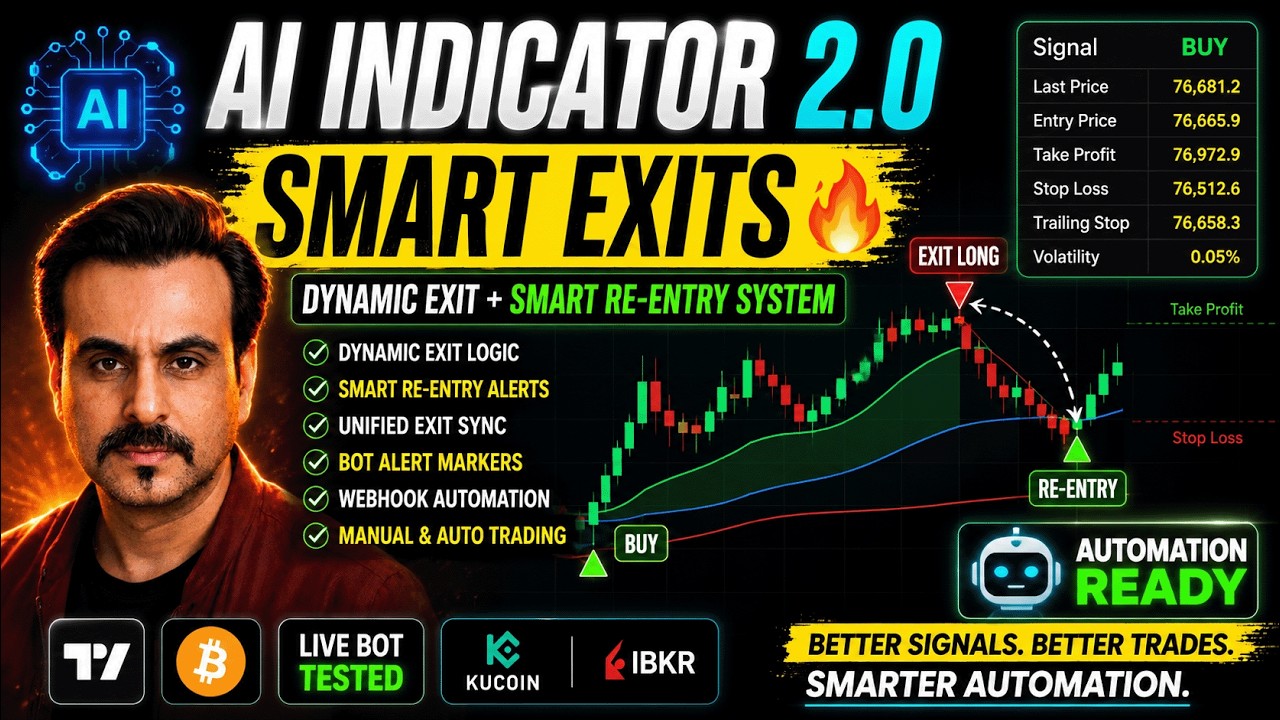
In this video, AstralAstrologer demonstrates a volume-led indicator with rule-based smart exits and automation, and that emphasis on confirming entries with participation and managing exits mechanically is exactly what this post translates into a structured GBPUSD volume-spike breakout system.